
Common Mistakes I See in GAMSAT Section 2 (and How to Score Well)
I scored in the top 0.5% for GAMSAT Section 2. Since then I've marked over 500 Section 2 essays through my free marking program and tutored lots of students who went on to score in the 80s, including students with ESL, ADHD and dyslexia. Across all of them I see the same mistakes over and over.
In this post I'll go through the most common ones, explain why they cost you marks, and show you how to avoid them.
It's a long post on purpose. Section 2 is one of the most misunderstood parts of the GAMSAT, and quick tips won't cut it.
Mistake 1: Misunderstanding what Section 2 is testing
Section 2 is officially called Written Communication, and that name is deliberate.
Your job isn't to write a sophisticated academic essay. It's to communicate clearly under pressure, which is very different to writing at school or uni.
At school or uni:
- you're often writing about a set text, topic or theory
- the marker already knows the background
- you can mention thinkers, dates, events or concepts without explaining them
- you can assume the marker knows your subject
In Section 2 you can't assume any of that. Assume the marker only has general, common knowledge.
I regularly read essays where I can't work out what the student is trying to say. It's not that their ideas are weak. It's that they haven't communicated them clearly. A lot of students write as if an economics professor, law lecturer or philosophy tutor is marking their essay. They aren't.
Why strong writers often struggle with Section 2
I tutor a lot of students from law or arts backgrounds. They write far better than I ever could and are much smarter than I'll ever be, but they're stuck in the 60s. The reason is simple: they overwrite. In Section 2, simple isn't bad. I scored in the top 0.5% without mentioning a single philosopher, and my language was very basic. Try giving your essay to a friend (one who didn't study law or arts) and see whether they can follow it easily.
Why does ACER test communication?
Communication is one of the most important skills a doctor or dentist has. Most of a doctor's job is communicating, often in high-pressure, emotional or time-critical situations. That's exactly what Section 2 is testing: whether you can communicate clearly under pressure.
Think about what this looks like in real clinical work:
- calling a senior doctor because a patient is getting worse and you need help urgently
- explaining a complicated diagnosis to a patient who has waited six hours in ED and is frustrated (while you're exhausted and need more coffee)
- talking through consent for surgery with a patient or their family at a stressful time
The skill underneath all of these is the same: clear, structured communication under pressure.
So even if Sections 1 and 3 don't seem very relevant to medicine or dentistry, Section 2 definitely is. It isn't testing whether you can write a "good essay". It's testing whether you can organise your thoughts, explain ideas clearly and guide someone through something complicated when it matters.
Mistake 2: Using pre-prepared or memorised essays
ACER is very clear about this in its official information booklet:
- every essay is run through plagiarism-detection software
- essays that are too similar to others are heavily penalised
That includes:
- essays from prep companies
- essays written by tutors
- memorised templates
- your own essays from previous ACER sittings
- essays from our new friend ChatGPT
Don't believe me? These screenshots are from ACER's own information booklet.
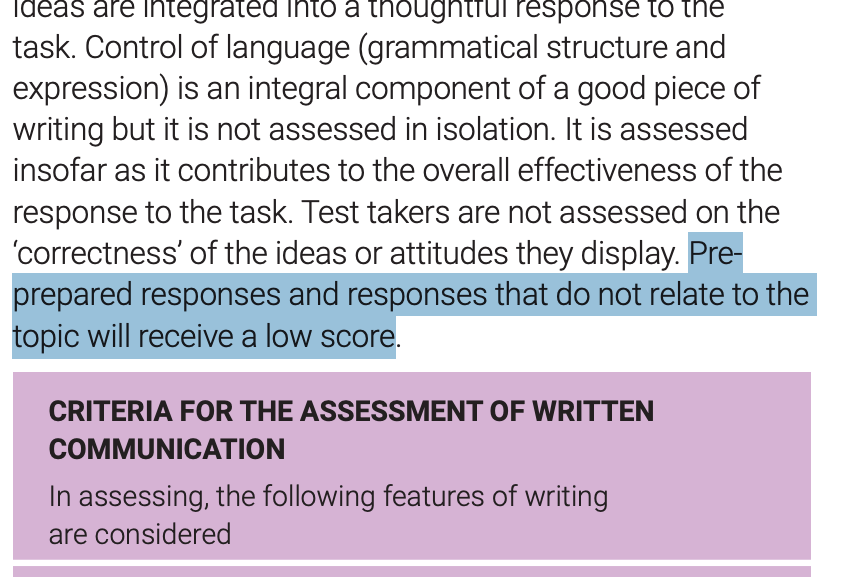
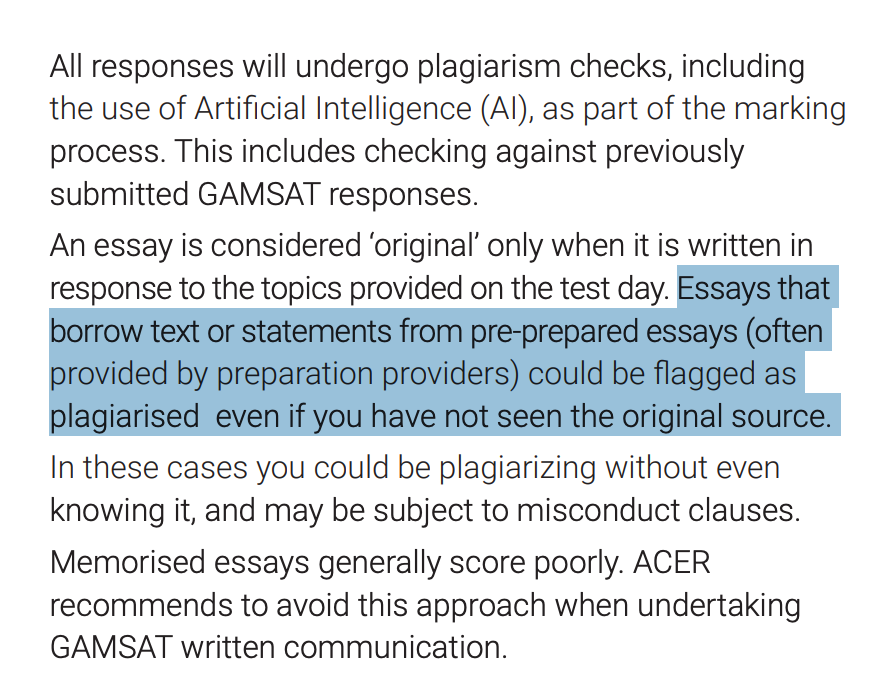
I can usually tell within about three sentences if an essay is memorised or pre-prepared (and when I ask, the student confirms it). The two big red flags are:
- the word "neoliberalism"
- being off theme
I understand why people want a memorised response or framework to fall back on. Writing to a structure is much easier than writing from scratch in a stressful exam. This isn't a criticism, just a warning.
If you do want to use memorisation or a framework, then instead of memorising paragraphs, memorise:
- arguments
- examples
- ways of thinking about issues
That way you can adapt to the theme, stay authentic and avoid plagiarism problems. If you score well in practice but badly in the real exam, ask yourself honestly whether you were really writing to the theme or forcing in something you'd prepared.
Mistake 3: Weak or missing structure (including in Task B)
Structure often gets ignored, especially in Task B. I get it, structure is boring. But skipping it is a mistake.
Both Task A and Task B need structure.
By the time I finish your introduction, I should know:
- what the essay is about
- what question or idea you're exploring
- where the essay is going
The structure doesn't have to be rigid, but it does have to be obvious. Clear signposting matters. If I can't see your structure from your introduction, it isn't strong enough.
My own high-scoring essays were:
- heavily structured
- very clearly signposted
- written in very simple language
Again, it all comes back to communication.
Mistake 4: Repeating ideas instead of developing them
This is one of the main reasons students get stuck in the 60s.
A lot of essays repeat the same idea across several paragraphs and just swap the example. That isn't developing your argument.
Each paragraph should:
- add something new
- take the argument further
- look at it from a different angle
- answer a different question
If the only difference between your paragraphs is the example, your ideas aren't moving forward, and your score will show it.
Mistake 5: Writing full essay after full essay
Lots of students think the best way to improve at Section 2 is to write essay after essay after essay. It rarely works, for two reasons.
1. You don't find the real problem
If your score is low, something specific is going wrong. Common problem areas are:
- brainstorming ideas
- writing clear introductions
- writing strong topic sentences
- developing ideas past the first paragraph
- staying on theme
Writing full essays over and over doesn't show you which of these is the problem, so you end up practising the same mistakes again and again.
2. You burn out
Section 2 practice is mentally draining. Writing full essays all the time leads to fatigue and frustration, and each one helps you less than the last.
A better way to practise
Work out what the problem is and practise that one skill on its own. For example:
- only write introductions
- only practise brainstorming themes
- only work on developing one paragraph in depth
- only practise topic sentences and signposting
Targeted practice improves your score faster and is much easier to keep up.
I built my Section 2 course around this. It helps you find your weak areas and then gives you specific drills for each one, so you can study effectively without burning out.
Final takeaway
Section 2 isn't about sounding impressive or academic, and it isn't about memorised brilliance.
It's about clear written communication under pressure.
So:
- choose clarity over complexity
- write directly to the theme
- don't use memorised essays
- use a clear structure
- make each paragraph build on the last
When you treat Section 2 as a communication task rather than an academic essay, your writing and your score both improve. You'll also be building the skill that matters most in medicine.
Want feedback on your Section 2 essays?